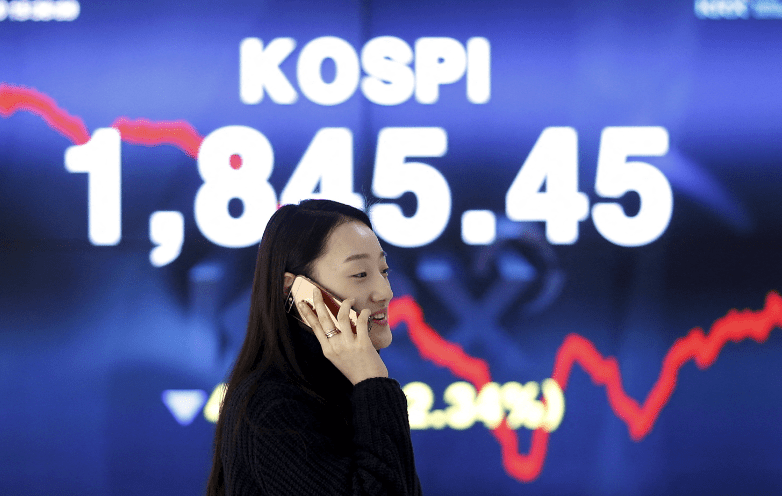
Korea Discount, or “K-Discount”, refers to the phenomenon where companies listed on the Korea Exchange (KRX) are undervalued compared to their global peers due to a combination of factors. The opposite of this is known as “Korea Premium.” Additionally, there exists a “KOSDAQ Discount,” where companies on the KOSDAQ market are undervalued compared to those on the KOSPI market.
Examples of Korea Discount
From 2010 to 2021, the average stock prices of South Korean companies, as measured by MSCI, were undervalued by approximately 36% compared to developed markets and by about 16% compared to emerging markets. This undervaluation has resulted in the formation of a “box pattern” in the KOSPI, marked by high volatility.
A study by Professor Lee Nam-Woo of Yonsei University found that in Korea, real estate returns have historically outperformed stock returns. In 16 developed countries, including Japan, the average return on stocks was 13%, while residential real estate averaged 12%. However, in Korea, Seoul apartments yielded an 8.5% return, compared to just 7% for stocks. Excluding Samsung Electronics, the stock return drops to 3%, significantly underperforming real estate.
Causes of the Korea Discount
Issues with Domestic Listed Companies: Leadership-Centric Management Culture
One of the primary reasons for the Korea Discount is the entrenched management culture in Korean companies. In South Korea, there is a prevalent belief that companies are personal assets of the controlling families, rather than being owned by shareholders. This results in a lack of incentive for outside investors to purchase shares.
Korean companies often neglect shareholder returns, such as dividends and share buybacks, and instead, accumulate retained earnings. Moreover, practices like unfair intra-group transactions, unfavorable merger ratios, embezzlement, and breach of trust are common. The dominant influence of major shareholders leads to a stock price heavily influenced by their actions, with minimal legal protection for minority shareholders.
Issues with Domestic Listed Companies: Low Dividends
Korean companies pay out only about 17% of their annual net profits to shareholders, compared to 97% in the U.S. (dividends and buybacks combined) and 73% globally. Inefficient asset management by executives further contributes to low returns. Consequently, investors, both domestic and international, prefer higher-yielding overseas stocks. This trend results in short-term, momentum-driven trading strategies in the Korean stock market, rather than long-term investments.
Issues with Domestic Listed Companies: Manufacturing-Centric Industrial Structure
The heavy reliance on manufacturing and cyclical industries also contributes to the Korea Discount. Many top-market-cap companies in Korea are in sectors with high earnings volatility and low predictability, leading to lower valuations. Additionally, a significant portion of these companies operates lower in the supply chain, making them more sensitive to fluctuations in interest rates and raw material prices, and resulting in lower margins and return on equity (ROE).
Issues with Domestic Listed Companies: Relatively Low International Credit Ratings
International credit ratings significantly impact a company’s valuation. While many Korean companies receive high domestic credit ratings, they often receive lower ratings from major international rating agencies like Moody’s, Fitch, and S&P Global. This discrepancy limits their recognition and attractiveness to foreign investors.
Issues with Domestic Listed Companies: Poor Fundamentals of Domestic Companies
The financial health of Korean companies has weakened over the years due to various economic crises and structural issues. Inadequate share buybacks, ineffective asset management, and a lack of continuous performance improvement have deterred both domestic and foreign investors. Only a handful of companies like Samsung Electronics, LG Household & Health Care, and Celltrion have consistently shown upward trends in performance and stock prices.
Issues with Domestic Listed Companies: Reckless Spin-Off Listings
Reckless spin-off listings of business units without adequate consideration for shareholder value have also contributed to the Korea Discount. Such practices dilute the value of existing shares and undermine investor confidence.
Governmental and Systemic Issues: Tax Policies
High inheritance and gift taxes, along with comprehensive taxation of dividend income, discourage companies from raising dividends. This, combined with corporate governance issues, reduces the attractiveness of Korean stocks to both domestic and foreign investors.
Governmental and Systemic Issues: Preferential Pardons for Economic Offenders
The frequent pardoning of business leaders convicted of financial crimes undermines the credibility and moral integrity of the Korean corporate sector. This practice erodes trust among investors and discourages long-term investments.
Governmental and Systemic Issues: Real Estate Preference
Due to the high volatility and perceived risks in the stock market, Koreans generally prefer real estate investments. This preference is reinforced by policies and cultural factors, leading to a cyclical undervaluation of the stock market and further exacerbating the Korea Discount.
 FinEducate
Leave a comment