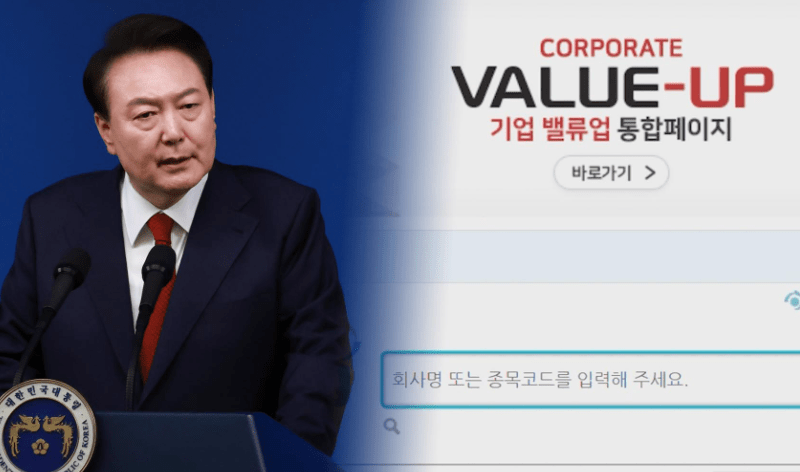
To tackle the persistent undervaluation of companies listed on the Korea Exchange, often referred to as the “Korea Discount,” the Yoon Suk-yeol administration has launched a Corporate Value-Up Program. This initiative is known to have drawn inspiration from similar policies implemented by the Japanese governments under Shinzo Abe and Fumio Kishida.
Program Specifics
In February 2024, the Yoon administration introduced a Corporate Value-Up Program modeled after successful strategies from Japan. The program began with public hearings and aims to develop indices and ETF products that group companies with a Price-to-Book Ratio (PBR) below 1, yet have strong cash flows.
The program also mandates that listed companies analyze and regularly report the reasons behind their undervaluation and submit plans to enhance their corporate value. Additional measures include expanding tax benefits for Individual Savings Accounts (ISA) and abolishing the financial investment income tax, part of a broader policy agenda leading up to the 22nd National Assembly elections.
This announcement led to a significant surge in the stock prices of large companies in the financial, utilities, and retail sectors listed on the KOSPI, including insurers, securities firms, and banks. Observers are keen to see if this momentum will extend beyond election-related themes.
However, skepticism arose on February 26th when the Financial Services Commission (FSC) announced that companies would voluntarily disclose and select corporate value enhancement plans once a year, with minimal enforcement or substantial tax benefits for participating firms.
Reactions
Economists
A May 2024 survey by the Korean Economic Association revealed that economists favor reducing inheritance taxes and revising the premium on major shareholders. They also support improving disincentive structures and providing multiple benefits to high-performing companies.
International Examples
Japan
In March 2023, Japan launched a program under the title “Management Actions Conscious of Capital Costs and Stock Prices.” By June, they established the JPX Prime Index, which included companies with a Return on Equity (ROE) exceeding their capital cost and a PBR over 1, thereby qualifying them for fund support. While non-participating companies were not penalized, the publication of the participating list exerted indirect pressure, encouraging broader participation.
These efforts paid off, as evidenced by the Nikkei 225 index reaching a 34-year high of 35,000 points on January 12, 2024, and hitting a record 39,098 points on February 22, 2024, surpassing the previous high of 38,915 points set on December 29, 1989.
China
On April 12, 2024, China’s State Council announced the “New Nine Measures,” a stock market stimulus program focusing on increasing dividend payments and share buybacks. The program mandates annual dividends, with an emphasis on distributing dividends before the Lunar New Year. Companies that fail to pay adequate dividends face penalties, including being designated as under special management and restrictions on major shareholders’ stock sales.
The Corporate Value-Up Program represents a strategic effort by the South Korean government to combat the Korea Discount and enhance the attractiveness of its stock market. By adopting best practices from Japan and China, the program aims to foster a more transparent and shareholder-friendly corporate environment, ultimately boosting investor confidence and market valuations.
 FinEducate
Leave a comment