
Venture capital, the lifeblood of innovation and entrepreneurship, has become an integral part of the modern business landscape. In this blog post, we embark on a mathematical case study exploring the allocation of funds to 15-20 promising venture capital startups. Join us as we navigate the seas of risk and reward, aiming to strike the right balance for a successful investment portfolio.
The Fund Allocation Strategy: The foundation of any successful venture capital portfolio lies in a well-thought-out allocation strategy. Diversification, risk mitigation, and a keen eye for potential winners are key elements. For our case study, let’s assume a hypothetical fund of $50 million earmarked for investment in 15-20 startups.
- Diversification: To mitigate risk, we’ll diversify the investment across different sectors, stages of development, and geographic locations. For example, we may allocate 30% to early-stage tech startups, 20% to biotech, 15% to fintech, and so on. This approach minimizes the impact of any single industry downturn on the overall portfolio.
- Investment Size: Each startup within the portfolio will receive a carefully considered investment based on its stage of development, market potential, and funding requirements. We might allocate larger amounts to more mature startups with proven traction and smaller amounts to early-stage ventures with higher risk.
- Risk-Adjusted Returns: We’ll assess the risk and return profile of each startup using various financial metrics such as the internal rate of return (IRR), net present value (NPV), and expected return on investment (ROI). This analysis will guide us in prioritizing startups that offer the best risk-adjusted returns.
- Follow-on Investments: Acknowledging that startups may require additional funding rounds, we’ll reserve a portion of the fund for follow-on investments in high-performing startups. This strategy allows us to capitalize on the success of promising ventures while managing risk.
Mathematical Model: Let’s illustrate our fund allocation strategy with a simplified mathematical model:
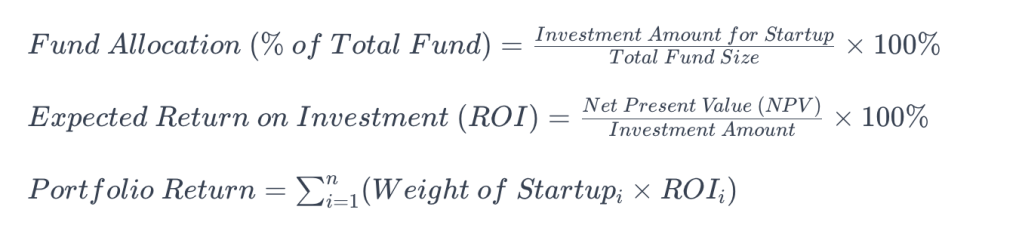
Conclusion: Venture capital investing is an art as much as it is a science. Our mathematical case study provides a framework for allocating funds to startups, emphasizing the importance of diversification, risk assessment, and a dynamic investment approach. As the venture capital landscape evolves, so too must our strategies, ensuring that our investments stand the test of time and contribute to the growth of groundbreaking
 FinEducate
Leave a comment